Intumescent mastic in Bedford
A tube of the right sealant closes a small gap. A tube of the wrong one closes nothing.
Get a priceIntumescent mastic is a sealant that swells when it gets hot.
You see it as a grey or white bead in a joint. In a fire, it expands and fills the gap, so flame and smoke cannot pass.
It is the right product for narrow, linear gaps. It is the wrong one for a large hole.
Where it belongs
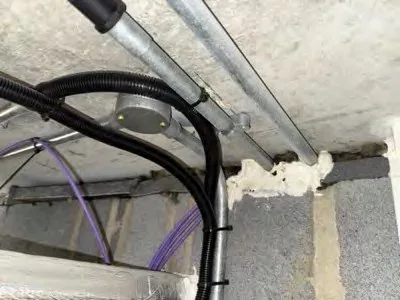
A joint where a fire-resisting board meets a wall. The edge of a service riser panel. The small gap round a single cable. The top of a partition where it meets the slab, when the gap is narrow.
It also goes round the edge of some other products, to finish what the main seal leaves.
Limits
Every mastic is tested to a maximum gap width and depth. Go over either, and the test no longer applies.
A thin bead pushed into a deep joint does little. A joint that has moved and opened up since it was filled will have cracked.
That is why we do not use mastic to fill a hand-sized hole. A board, a batt or a pillow does that, with mastic only on the edges.
What we see done wrong
White decorator's caulk in a joint. It looks the part. It is not intumescent and it will not swell.
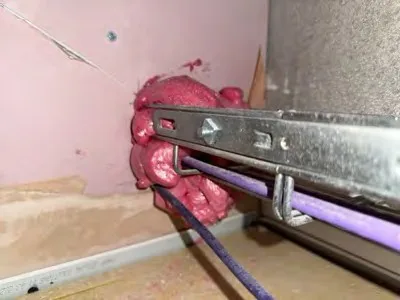
Mastic in a gap that is far too wide, smeared thick over the top.
A good bead in the right gap, with a wire running through the middle of it that was never accounted for.
Paint over the top, so nobody can read the product on the tube or know what is in there.
How we check
On a survey we look at what is in the joint. Many mastics look different from ordinary caulk, but where we cannot tell, the report says so and we recommend it is redone.
The work is carried out by our BM TRADA / FIRAS-certificated contractors. Each treated joint is photographed.
Made-up jobs
Cable opening. An 80mm hole through 100mm blockwork, six cables in it, a gap all round. Dust out first. Mineral wool in to the depth on the data sheet, say 100mm. A bead of mastic round each cable and round the edge of the hole, tooled flat with a wet finger. Photo before it skins over, photo after.
Riser panel. Plasterboard, 3mm open along the edge. Mastic gun, one pass, wipe flat.
Top of a wall. 15mm to the slab. Bead run down the open side.
A 5mm joint and a 20mm joint are not the same case, so put a coin in the photo. Paint is a data sheet matter, because one product takes emulsion and another names a paint. If the wall flexes or someone pulls more cable through, cut the old bead out and run a new one.
The work is carried out by our BM TRADA / FIRAS-certificated contractors. Joints are priced by length. The same mastic closes the edge of a cavity barrier, and bigger openings are under penetration sealing.
Tell us the building, how many floors and what has been found. We will say what we need to see and give you a rough estimate.
Get a price