Fire collars and pipe wraps in Bedford
Plastic pipes melt in a fire. A collar or wrap closes the hole they leave.
Get a priceTake a plastic waste pipe through a floor in a block of flats.
In a fire, the pipe softens and burns away. If nothing is round it, you now have a round hole in the floor, the full width of the pipe, joining one flat to the one below.
That is the problem a collar or a wrap solves.
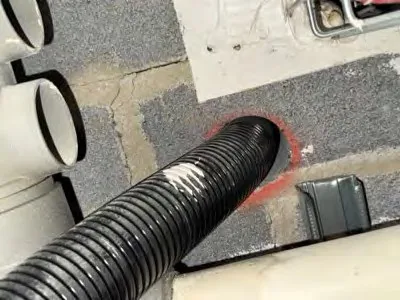
How a collar works
A collar is a metal band lined with material that swells when it gets hot. It is fitted round the pipe at the underside of the floor, where the pipe comes through.
When the heat arrives, the lining expands inward and squeezes the softening pipe shut. The hole stays closed even after the pipe has gone.
On a wall, they are fitted on both faces.
How a wrap works
A wrap is a strip of the same kind of material, wound round the pipe a set number of times and pushed into the opening.
It is used where there is no room for a collar, or where the pipe goes through a thin wall. The number of turns depends on the pipe size, the product and the wall, so it is not a guess.
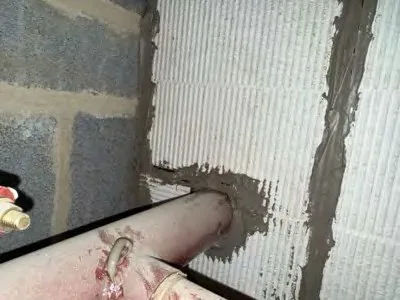
What can go wrong
Collars fitted to the wrong pipe size. A collar made for one diameter will not do the job on another.
Collars on only one side of a wall that needs both.
Collars fixed with the wrong screws, or into plasterboard that falls away in a fire.
Pipes that have been replaced since the collar went on, so the collar sits round the wrong pipe or round nothing.
Boxing built round a pipe later, which hides the collar so nobody knows if there is one.
Where we find them missing
In risers and service cupboards, mostly. Also under kitchens and bathrooms, where a new waste pipe went in and the plumber was not asked to seal it.
A compartmentation survey finds them in one visit. The fitting is done by our BM TRADA / FIRAS-certificated contractors.
Metal pipes
Not every pipe needs a collar. Metal pipes do not melt the same way, and the gap round them is dealt with by penetration sealing. Insulation on a pipe is a separate question, and a good reason to ask before anyone puts the wrong product on.
Getting a price
Tell us how many pipes, what size they are and where they pass through. Photos of each one, with a tape beside it, are better than a long description.
Questions we get asked
Do I need a collar on every plastic pipe?
On a pipe passing through a fire-resisting floor or wall, usually yes, unless the tested system says otherwise. That is why it should be checked pipe by pipe.
Can I fit them myself?
You can buy them. Fitted wrongly they give a false sense of safety, so we would rather the pipe went on a proper list.
Tell us the building, how many floors and what has been found. We will say what we need to see and give you a rough estimate.
Get a price